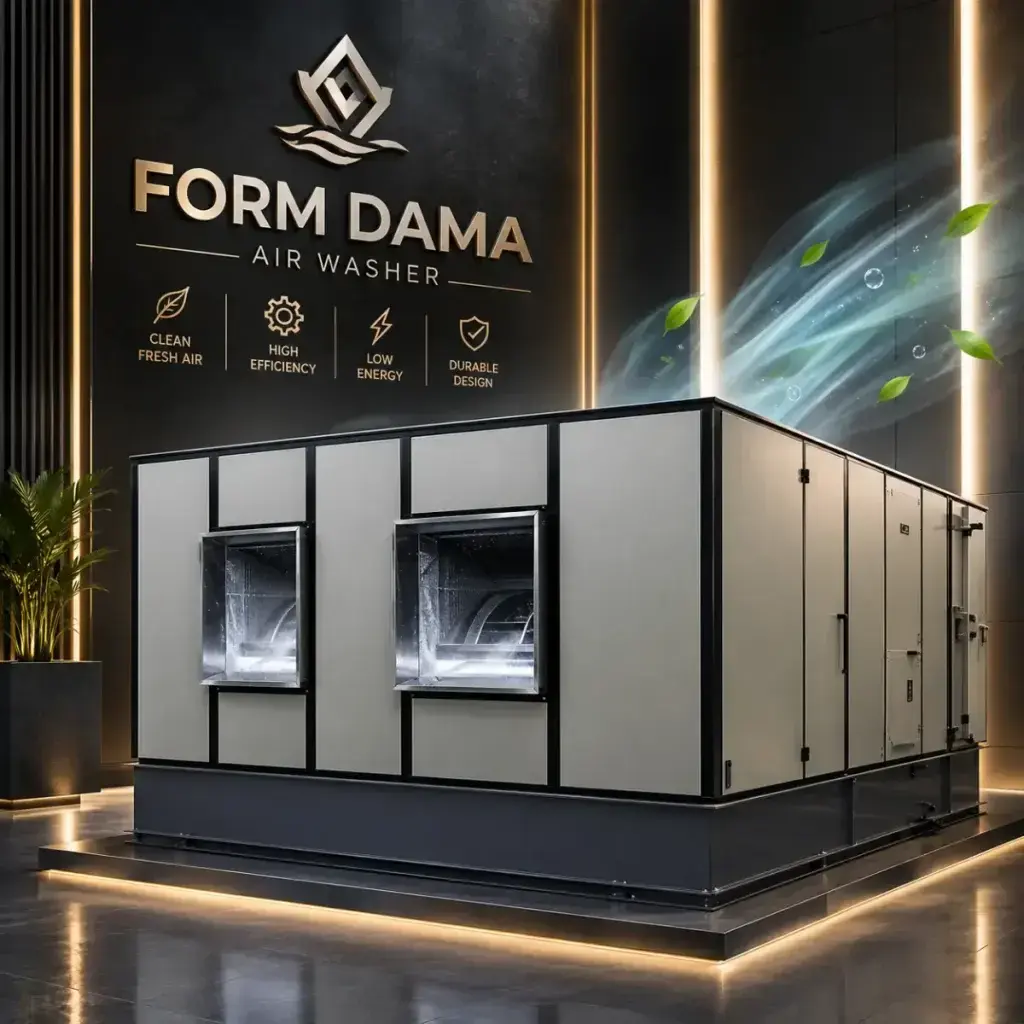
Industrial facilities that need clean, humidity-controlled, and temperature-stable air rely on one piece of equipment more than almost any other: the air washer. An industrial air washer system combines evaporative cooling, mechanical filtration, and humidity control in a single unit, making it one of the most cost-effective ways to condition large volumes of air in demanding environments — from textile mills and pharmaceutical plants to foundries, warehouses, and cleanrooms.
Unlike conventional refrigerant-based air conditioners, an industrial air washer cools and cleans air using nothing more than water and airflow, which is why manufacturers, plant engineers, and facility managers increasingly turn to it as a low-energy alternative for high-volume air treatment. Whether the goal is dust removal, precise humidity control, or simply cutting the electricity bill on a large production hall, an air washer unit can be engineered to fit the exact airflow and hygiene requirements of the facility.
In this guide, we’ll break down exactly how an industrial air washer system works stage by stage (with a full breakdown of its internal diagram), the different types of air washers available, their core components, and the real-world industrial uses where this equipment delivers the biggest return — so you can decide whether it’s the right fit for your facility, and which configuration to specify.
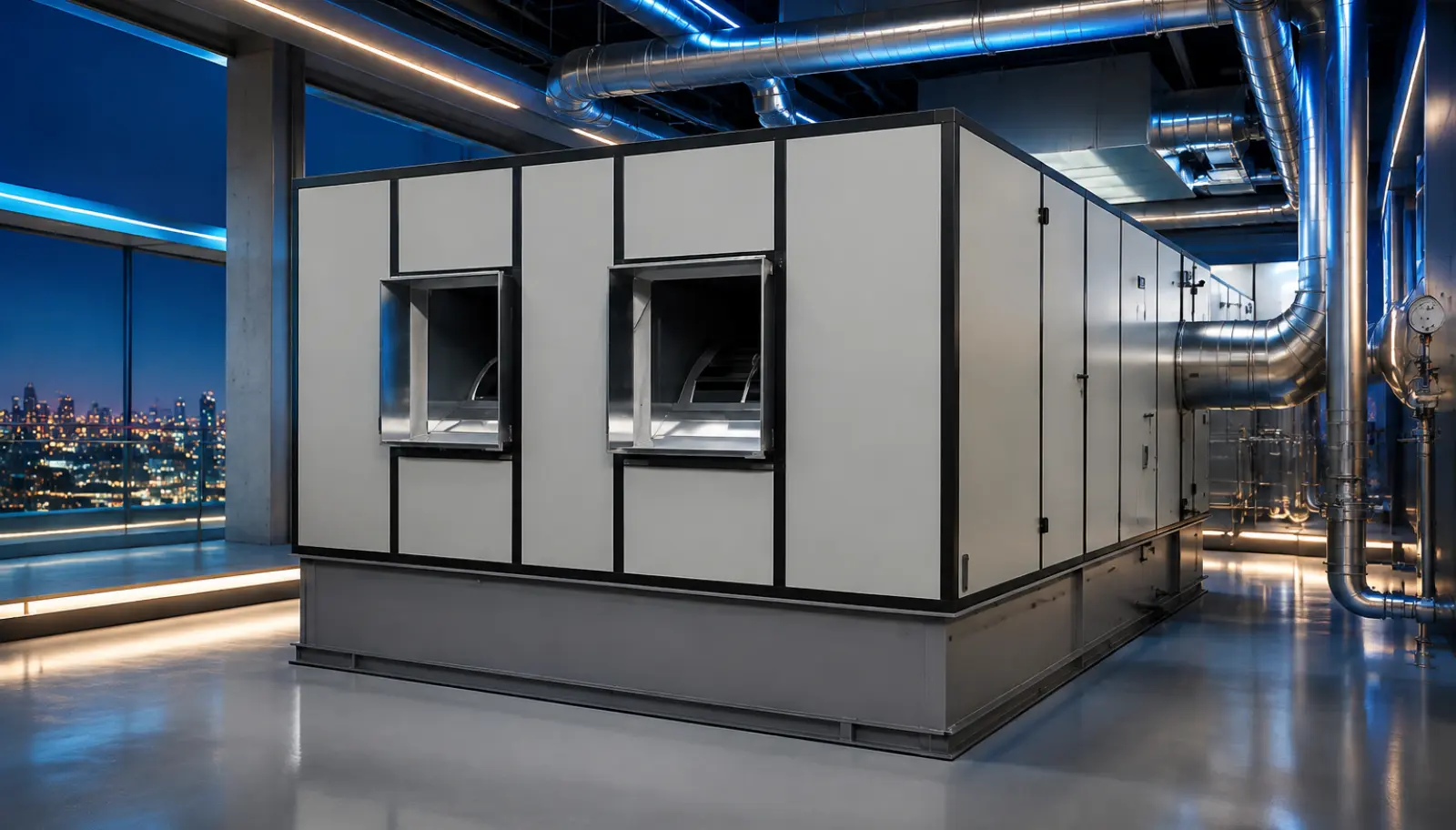
An industrial air washer is a piece of HVAC equipment that conditions air by passing it through a fine water spray or a wetted media bed. As air moves through the unit, water absorbs dust, pollen, and airborne particles while simultaneously cooling and humidifying (or dehumidifying) the air stream. Unlike a standard air conditioner, an air washer doesn’t rely primarily on refrigerant-based cooling — it uses the natural evaporative cooling effect of water, which makes it significantly more energy-efficient for large-scale or continuous industrial operation.
This is why industrial air washer systems are so common in facilities where both air quality and energy cost matter: textile mills, printing plants, pharmaceutical production, food processing, and large warehouses.
Understanding the internal layout makes it much easier to picture how the system actually functions. A typical industrial air washer works through the following stages:
Picture the airflow like this: dirty/warm air in → filtered → passed through water spray/media → moisture eliminated → clean, cooled air out through the fan. This sequence is the “diagram” behind every industrial air washer, regardless of brand or size — only the chamber design and media type change between models.
Not all air washers are built the same. The main types you’ll come across are:
Industrial air washer units are used wherever a facility needs to combine air cooling, humidification/dehumidification, and dust or particulate removal at scale. Common applications include:
Compared to conventional refrigerant-based cooling, industrial air washer systems offer:
Specifying the correct industrial air washer system is an engineering decision, not a one-size-fits-all purchase. Two facilities in the same industry can require completely different configurations once you account for local climate, production process, and hygiene class. Before selecting a unit, it’s worth evaluating the following factors in detail:
Evaporative cooling performance depends heavily on the wet-bulb temperature of the incoming air. In hot, dry climates, a standard wetted-media or spray-type air washer can achieve significant cooling with minimal energy input. In hot, humid climates, evaporative cooling alone may not be enough, and the system may need to be paired with chilled-water coils or used primarily for filtration and moderate humidity control rather than deep cooling.
Some industries — textiles, printing, paper, tobacco, and pharmaceuticals — operate within a narrow relative humidity band that directly affects product quality. For these applications, a spray-type air washer with automated humidity control and precise water temperature regulation is usually the better choice over a simple wetted-media unit.
عایقکاری فن کویل و چیلر در اراک با اجرای اصولی، کاهش اتلاف انرژی و جلوگیری از تعریق لولهها. بررسی روش اجرا، هزینه و اشتباهات رایج توسط فرم دما.
➜ مطالعه مقاله کاملFacilities with heavy airborne particulates, such as foundries, cement plants, or woodworking operations, need an air washer with a higher water-to-air contact ratio and a more robust eliminator section to prevent water saturation and re-entrainment of captured dust. Multi-stage air washers are often specified here.
Cleanrooms, hospitals, food processing lines, and pharmaceutical facilities require hygienic-grade air washers — stainless steel chambers, UV or ozone disinfection, and closed water-treatment loops — to prevent microbial growth inside the unit itself. A standard industrial unit is not appropriate for these environments, regardless of its cooling capacity.
Since the entire system depends on recirculated water, local water hardness, mineral content, and availability affect both the maintenance schedule and the bleed-off/makeup water design. Facilities in regions with hard water typically need additional water treatment or more frequent bleed-off cycles to prevent scale buildup on nozzles and media.
The required CFM (cubic feet per minute) of the space determines the fan size, chamber dimensions, and whether a single centralized unit or several smaller distributed units is the more practical and energy-efficient layout.
Air washers are already far more energy-efficient than compressor-based cooling, but the choice between a basic wetted-media design and a more automated, sensor-controlled spray system will affect both upfront cost and long-term operating expense. Facilities running 24/7 production usually see a faster return on investment from higher-end, automated configurations.
Formdama designs and manufactures industrial air washer systems engineered around these exact variables — from standard wetted-media units for general industrial ventilation, to fully hygienic, stainless-steel configurations built for cleanrooms and pharmaceutical-grade environments. Our engineering team reviews your facility’s climate data, process requirements, and hygiene class before recommending a configuration, rather than offering a generic, off-the-shelf unit.
An industrial air washer system remains one of the most reliable and energy-efficient ways to combine cooling, humidity control, and air filtration in a single piece of equipment. The right choice, however, depends entirely on getting the details right: climate, humidity targets, dust load, hygiene class, and water conditions all shape which type of air washer — and which components — will actually perform as expected once installed. Facilities that take the time to match these variables to the correct configuration consistently see lower energy bills, more stable production conditions, and fewer maintenance issues down the line than those that install a generic, undersized, or mismatched unit.
An industrial air washer system is used to cool, humidify or dehumidify, and filter large volumes of air in industrial facilities. It’s commonly applied in textile mills, pharmaceutical plants, food processing lines, foundries, warehouses, and cleanrooms where both air quality and energy efficiency matter.
Learn what an air conditioner is, how it works, its main components, different types, and key benefits. Discover how air conditioning systems improve indoor comfort and energy efficiency.
➜ مطالعه مقاله کاملThey both use the evaporative cooling principle, but an industrial air washer is engineered for much higher airflow volumes, precise humidity control, and integrated filtration, making it suitable for continuous industrial operation rather than simple, small-scale space cooling.
Air enters through an intake filter, passes through a water spray or wetted media chamber where it’s cooled, humidified, and stripped of particulates, then moves through a moisture eliminator section before a fan pushes the conditioned air into the ductwork. Water is continuously recirculated through a pump and sump tank.
Yes. Depending on the incoming air condition and the temperature of the water used in the spray or media section, an air washer can add moisture to dry air, or, when supplied with chilled water, remove moisture from humid air.
Water usage depends on the airflow volume and recirculation design, but most industrial air washers use a closed-loop recirculation system with a bleed-off valve, which significantly reduces fresh water consumption compared to a single-pass water system.
Yes, but only hygienic-grade models. These use stainless steel chambers, UV or ozone disinfection, and closed water-treatment loops specifically designed to prevent microbial growth, making them suitable for cleanrooms, hospitals, and pharmaceutical production environments.
The main types are spray-type air washers, wetted media (cellulose pad) air washers, hygienic air washers for sensitive environments, and multi-stage air washers that combine several spray or media banks for facilities with heavy dust and cooling loads.
Because industrial air washers rely on evaporative cooling rather than a refrigerant compressor cycle, they typically consume only a fraction of the electricity used by conventional AC systems of comparable airflow capacity, especially in hot, dry climates.
Routine maintenance includes cleaning or replacing wetted media pads, checking spray nozzles for mineral scale, inspecting the moisture eliminator baffles, and monitoring water quality in the recirculation tank to prevent buildup or microbial growth.
The right system depends on your local climate, required humidity range, dust load, hygiene requirements, water quality, and total airflow volume. A qualified HVAC engineering team should review these factors before recommending a wetted-media, spray-type, hygienic, or multi-stage configuration.