



Description
Fiberglass Cooling Tower by Form Dama | Industrial Cooling Solutions
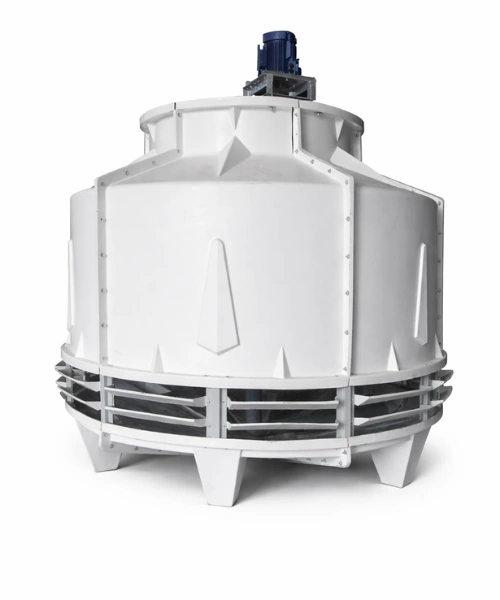
Form Dama Fiberglass Cooling Tower: Efficient, Durable, and Engineered for Industrial Applications
The Form Dama Fiberglass Cooling Tower is designed to support efficient heat rejection in industrial facilities, commercial buildings, and HVAC systems. Featuring a cylindrical fiberglass-reinforced plastic (FRP) structure, corrosion-resistant components, and a high-performance water distribution system, this cooling tower offers a practical solution for applications requiring reliable thermal performance, structural durability, and reduced maintenance requirements.
Available in 28 models with nominal cooling capacities ranging from 8 to 1,250 refrigeration tons, Form Dama fiberglass cooling towers are suitable for a variety of cooling requirements, including water-cooled chiller systems and absorption chillers. Their lightweight construction, UV-resistant exterior, and modular assembly design facilitate installation in different operating environments, including rooftop installations and locations exposed to wind and direct sunlight.
The selection of an appropriate cooling tower depends on the required heat rejection capacity, entering and leaving water temperatures, ambient wet-bulb temperature, water flow rate, and site-specific operating conditions.
Key Advantages of Form Dama Fiberglass Cooling Towers
1. Durable Fiberglass Construction
The cooling tower body, water collection basin, and air intake louvers are manufactured from fiberglass-reinforced materials designed for outdoor operation. The smooth surface of the fiberglass structure facilitates cleaning and helps reduce the accumulation of deposits on accessible surfaces.
Unlike conventional steel structures, fiberglass components offer inherent resistance to corrosion under many humid operating conditions. This property makes fiberglass cooling towers a suitable option for environments where continuous exposure to moisture and water spray can accelerate the deterioration of less corrosion-resistant materials.
2. Cylindrical Design for Wind-Exposed Installations
The cylindrical configuration of Form Dama cooling towers provides an aerodynamic profile that can be advantageous for rooftop installations and elevated locations exposed to wind.
The absence of sharp external corners and the rounded geometry may help reduce localized wind pressure compared with certain geometries of equivalent projected area. However, actual wind loads depend on the tower dimensions, installation height, surrounding structures, wind direction, and applicable structural design requirements.
For high-rise buildings and exposed rooftops, the supporting structure and anchorage should be evaluated in accordance with the relevant local building codes and project-specific wind-load calculations.
3. UV-Resistant Exterior Surfaces
Fiberglass components exposed to direct sunlight incorporate UV-resistant protective materials intended to improve outdoor durability and maintain their surface appearance.
Resistance to ultraviolet radiation helps limit premature surface degradation and discoloration. Actual long-term performance depends on the resin system, protective coating, environmental exposure, and maintenance practices.
4. Hot-Dip Galvanized Metal Components
Metal components used for structural supports and selected connections, including applicable motor and fan mounting hardware, ladders, bolts, and fasteners, are specified with hot-dip galvanizing.
This protective treatment provides a zinc coating that helps protect steel against corrosion in humid environments and areas exposed to water spray.
The service life of galvanized components depends on coating thickness, water chemistry, exposure conditions, installation quality, and the maintenance of protective surfaces.
5. Balanced Axial Fans for Reliable Operation
Form Dama fiberglass cooling towers use axial fans manufactured from fiberglass or aluminum, depending on the selected configuration.
The fans are statically and dynamically balanced to help minimize vibration, support stable operation, and reduce unnecessary mechanical stress on the rotating assembly.
Fan balancing documentation and associated technical records are provided with the equipment. Appropriate fan selection and balancing are important factors in achieving reliable airflow and maintaining acceptable vibration levels during operation.
6. Efficient Water Distribution System
The cooling towers feature a rotary water distribution system designed to distribute circulating water across the heat-transfer section.
Uniform water distribution is essential for effective contact between the water and the air stream. Proper distribution helps utilize the available fill surface, supports consistent thermal performance, and reduces the risk of localized dry areas within the fill.
Actual cooling efficiency depends on the combined performance of the fill, water distribution system, fan airflow, circulating water rate, and ambient wet-bulb temperature.
7. Low Energy Consumption and Reduced Operating Noise
The lightweight fiberglass construction and appropriately selected fan and motor assemblies support an efficient equipment configuration.
Electrical consumption depends primarily on the selected motor power, fan operating point, airflow requirements, and system resistance. Similarly, noise levels depend on fan speed, blade design, motor characteristics, installation conditions, and the surrounding acoustic environment.
For projects with strict noise limitations, optional sound attenuation equipment can be considered according to the installation requirements.
8. Modular Assembly and Flexible Installation
The cooling tower is designed to facilitate assembly and disassembly, simplifying transportation, handling, and installation where site access is limited.
Its lightweight construction can also reduce handling requirements compared with certain heavier structural alternatives. Nevertheless, lifting arrangements, transportation constraints, foundation loads, and access clearances should be verified for each selected model.
9. Flexible Appearance and Configuration Options
Different color options are available to help coordinate the equipment with the architectural and operational requirements of the installation site.
Additional sound attenuation equipment may also be specified upon request, subject to the selected model and project requirements.
Technical Specifications of Form Dama Fiberglass Cooling Towers
Technical note: The stated capacity range represents the available product range, not a guaranteed thermal output under all operating conditions. Final selection must be based on the manufacturer’s performance data and the project’s specified design conditions.
Applications of Form Dama Fiberglass Cooling Towers
Form Dama fiberglass cooling towers can be considered for the following applications, subject to the selected model and engineering requirements:
- HVAC systems: Heat rejection for water-cooled chiller installations in commercial and institutional buildings.
- Industrial facilities: Cooling-water circuits serving compatible industrial processes.
- Absorption chiller systems: Heat rejection for absorption refrigeration equipment operating within the specified design conditions.
- High-rise buildings: Rooftop installations where equipment weight, wind exposure, access, and structural loads require careful consideration.
- Commercial complexes: Cooling infrastructure for facilities with continuous or seasonal thermal loads.
- Outdoor mechanical installations: Applications requiring moisture-resistant construction and protection against direct sunlight.
How to Select the Right Fiberglass Cooling Tower
Selecting a cooling tower solely by nominal tonnage may result in insufficient thermal performance or unnecessary energy consumption. A proper engineering assessment should consider the following parameters.
Required Heat Rejection Capacity
The cooling tower must reject the total heat transferred to the circulating water, including the heat absorbed by the chiller evaporator and the compressor energy input where applicable.
For a water-cooled vapor-compression chiller, the condenser heat rejection load is generally greater than the refrigeration load.
For an absorption chiller, the heat rejection requirement also depends on the heat input to the generator and the system’s thermal performance.
Entering and Leaving Water Temperatures
The cooling tower selection must specify the hot-water temperature entering the tower and the cold-water temperature required at the outlet.
The difference between these temperatures is known as the cooling range:
Cooling range = Hot-water temperature − Cold-water temperature
The cooling range is a key parameter in determining the required heat rejection duty.
Ambient Wet-Bulb Temperature
The entering air’s wet-bulb temperature is one of the principal factors governing cooling tower performance.
The difference between the leaving cold-water temperature and the entering air wet-bulb temperature is called the approach:
Approach = Cold-water temperature − Entering air wet-bulb temperature
A smaller approach generally requires a larger heat-transfer surface and/or greater airflow, depending on the design. Therefore, cooling tower performance should be evaluated at the project’s actual design wet-bulb temperature rather than on ambient dry-bulb temperature alone.
Water Flow Rate and Airflow
The circulating water flow rate and the airflow generated by the axial fan must be compatible with the specified thermal duty.
Insufficient airflow, poor water distribution, excessive fill fouling, or an incorrect water flow rate can reduce cooling performance and increase operating costs.
Installation and Environmental Conditions
The installation assessment should include:
- Available footprint and equipment height.
- Structural support and foundation requirements.
- Rooftop wind loads and anchorage.
- Air intake and discharge clearances.
- Potential recirculation of warm, humid discharge air.
- Noise restrictions and neighboring occupied areas.
- Water quality, scaling potential, and corrosion control.
- Access for inspection, cleaning, and maintenance.
Maintenance Recommendations
Routine maintenance is essential for maintaining thermal performance, mechanical reliability, and water quality.
Recommended inspection activities include:
- Water distribution system: Inspect rotary distribution components, spray nozzles, and water distribution patterns for blockage or uneven flow.
- Cooling tower fill: Check for scaling, biological fouling, physical damage, and obstructions that may restrict airflow or water flow.
- Fan and motor assembly: Inspect bearings, fasteners, vibration, electrical connections, and fan blade condition in accordance with the manufacturer’s instructions.
- Structural components: Examine fiberglass surfaces, galvanized steel parts, supports, and connections for damage or deterioration.
- Water collection basin: Remove accumulated debris and inspect basin cleanliness, drainage, and water level controls.
- Water treatment: Monitor water chemistry and implement an appropriate treatment program to manage scale, corrosion, suspended solids, and microbiological growth.
- Safety and hygiene: Implement suitable water management procedures to control the risk of Legionella and other waterborne microorganisms.
Maintenance intervals should be determined according to the operating environment, water quality, duty cycle, manufacturer’s recommendations, and applicable health and safety requirements.
Frequently Asked Questions About Form Dama Fiberglass Cooling Towers
1. What is the capacity range of Form Dama fiberglass cooling towers?
Form Dama offers fiberglass cooling towers in a stated capacity range of 8 to 1,250 refrigeration tons across 28 models. The appropriate model must be selected using the required heat rejection duty and the manufacturer’s performance data at the specified operating conditions.
2. What are the advantages of a fiberglass cooling tower compared with a metal cooling tower?
Fiberglass-reinforced plastic offers low structural weight and good resistance to corrosion in many humid and water-exposed environments. It can also provide a durable exterior when manufactured with suitable resin and UV protection.
The overall advantages depend on the specific materials, operating conditions, structural design, maintenance requirements, and total lifecycle cost. Fiberglass does not eliminate the need for inspection or water treatment.
3. Why is a cylindrical cooling tower suitable for rooftop installations?
A cylindrical configuration can provide favorable aerodynamic characteristics and avoid the sharp corners present in some alternative geometries. This can be beneficial at exposed elevations.
However, the suitability of a rooftop installation must be verified through project-specific wind-load calculations, structural checks, anchorage design, and assessment of the surrounding building geometry.
4. Can a Form Dama fiberglass cooling tower operate with water-cooled chillers?
Yes. The stated application range includes water-cooled chiller systems. The selected cooling tower must match the chiller manufacturer’s required condenser-water flow rate, entering and leaving water temperatures, and design heat rejection load.
5. Are these cooling towers compatible with absorption chillers?
The product range is specified for use with absorption chillers. Compatibility must be confirmed against the absorption chiller’s operating requirements, including heat rejection capacity, water flow rate, temperature limits, and design ambient conditions.
6. What is the difference between cooling capacity and heat rejection capacity?
Cooling capacity describes the rate at which a refrigeration system removes heat from the conditioned space or process. Heat rejection capacity describes the total thermal energy that the cooling tower must transfer from the circulating water to the atmosphere.
For a vapor-compression chiller, the condenser generally rejects both the heat removed from the chilled-water circuit and the compressor’s energy input. Consequently, cooling tower selection should not be based on the chiller’s refrigeration capacity alone.
7. What is the difference between cooling range and approach?
The cooling range is the difference between the hot water entering the tower and the cold water leaving it.
The approach is the difference between the cold-water outlet temperature and the entering air wet-bulb temperature.
The range describes the temperature reduction across the tower, whereas the approach indicates how closely the tower cools the water toward the ambient wet-bulb temperature.
8. How does wet-bulb temperature affect cooling tower performance?
The entering air wet-bulb temperature establishes an important practical limit for evaporative cooling performance. As the wet-bulb temperature increases, the tower generally produces warmer leaving water for the same equipment configuration and thermal load.
Cooling tower capacity must therefore be evaluated at the design wet-bulb temperature for the installation location.
9. Are Form Dama fiberglass cooling towers resistant to ultraviolet radiation?
The fiberglass body, basin, and air louvers are specified with UV-resistant protection for outdoor applications. This protection is intended to limit deterioration caused by solar exposure. Actual resistance to long-term exposure depends on the materials and protective system used in the selected model.
10. What is the purpose of static and dynamic fan balancing?
Static balancing addresses uneven mass distribution that produces an imbalance in a stationary rotor, while dynamic balancing evaluates rotor imbalance during rotation.
Proper balancing helps reduce vibration, mechanical loading, and noise associated with imbalance. It does not eliminate vibration caused by other issues, such as misalignment, bearing wear, structural resonance, or improper installation.
11. Does a fiberglass cooling tower require regular maintenance?
Yes. Fiberglass construction reduces certain corrosion-related concerns but does not eliminate the need for maintenance. The fill, water distribution system, basin, fan, motor, fasteners, and water treatment system require periodic inspection and servicing.
A suitable water management program is particularly important for preventing scale, biological fouling, and microbiological hazards.
12. Can noise reduction equipment be installed on a fiberglass cooling tower?
Optional sound attenuation equipment can be considered upon customer request, subject to model compatibility and the installation requirements. Noise reduction measures should be evaluated against the required airflow, fan operating point, available space, and acceptable sound levels.
13. What information is required to select the correct cooling tower model?
A preliminary selection typically requires the following information:
- Required heat rejection capacity in kW or refrigeration tons.
- Hot-water inlet and cold-water outlet temperatures.
- Design entering-air wet-bulb temperature.
- Circulating water flow rate.
- Installation location and altitude.
- Available footprint and maximum equipment height.
- Noise restrictions and site-specific wind conditions.
- Water quality and operating schedule.
These parameters allow the engineering team to assess the appropriate model and verify performance against the project’s design requirements.
Form Dama: Engineered Cooling Tower Solutions
The Form Dama fiberglass cooling tower range provides a combination of lightweight FRP construction, outdoor durability, axial fan technology, rotary water distribution, and flexible installation options for industrial and commercial cooling applications.
With capacities ranging from 8 to 1,250 refrigeration tons across 28 models, the product range can address different HVAC and process-cooling requirements when correctly selected and configured.
For reliable operation, the final equipment specification should be based on verified thermal performance, project-specific environmental conditions, structural requirements, and the manufacturer’s technical documentation.
For technical consultation and cooling tower selection, contact Form Dama to discuss your required heat rejection capacity, operating temperatures, water flow rate, and installation conditions.


Reviews
There are no reviews yet.